Product Gallery
Ultra-Thin, Flexible, Die-Cut to Your Coil
Nanocrystalline alloy ribbon laminated to film and adhesive — the high-permeability layer for RX coils, FPC antennas and low-frequency EMI shielding.
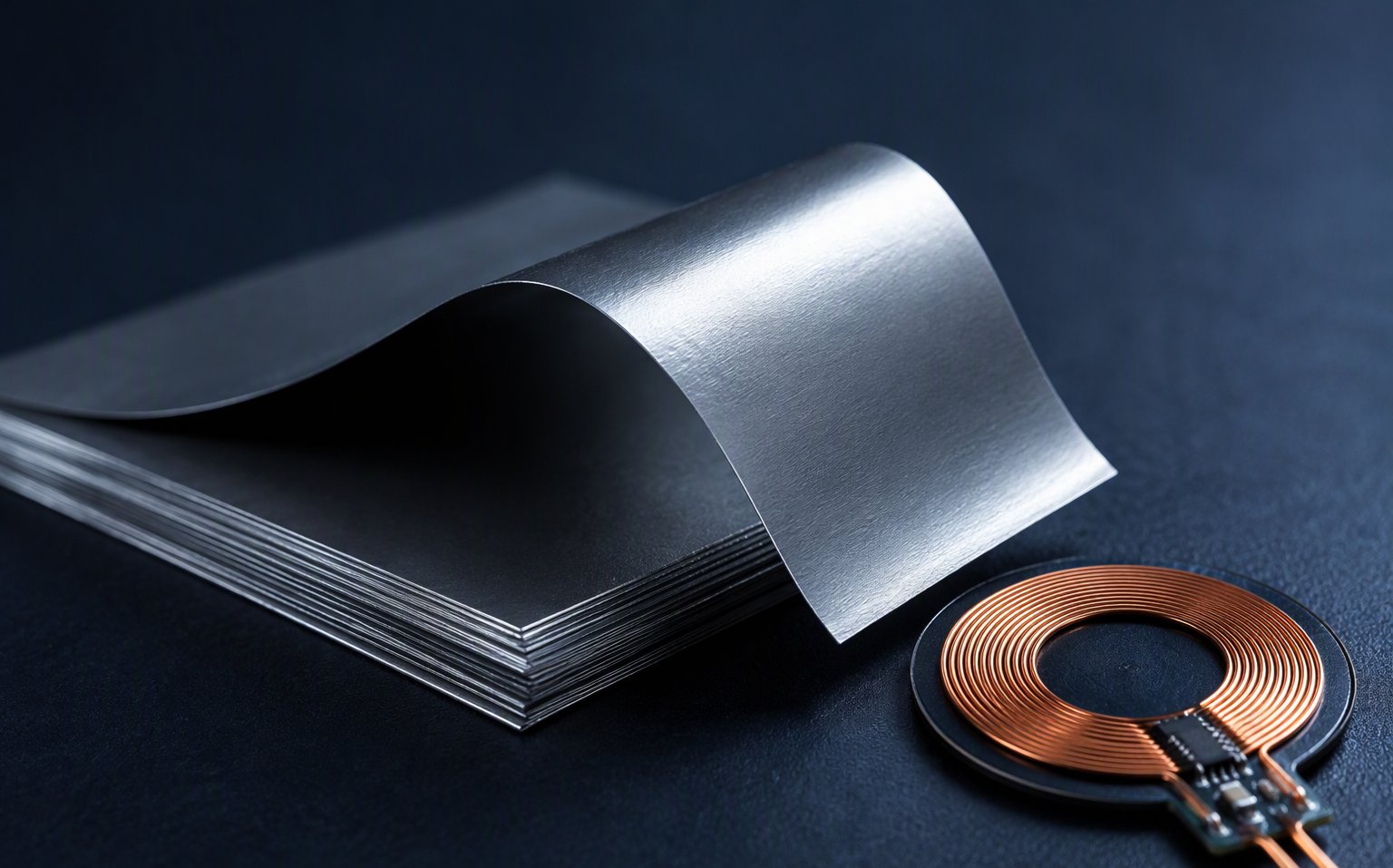
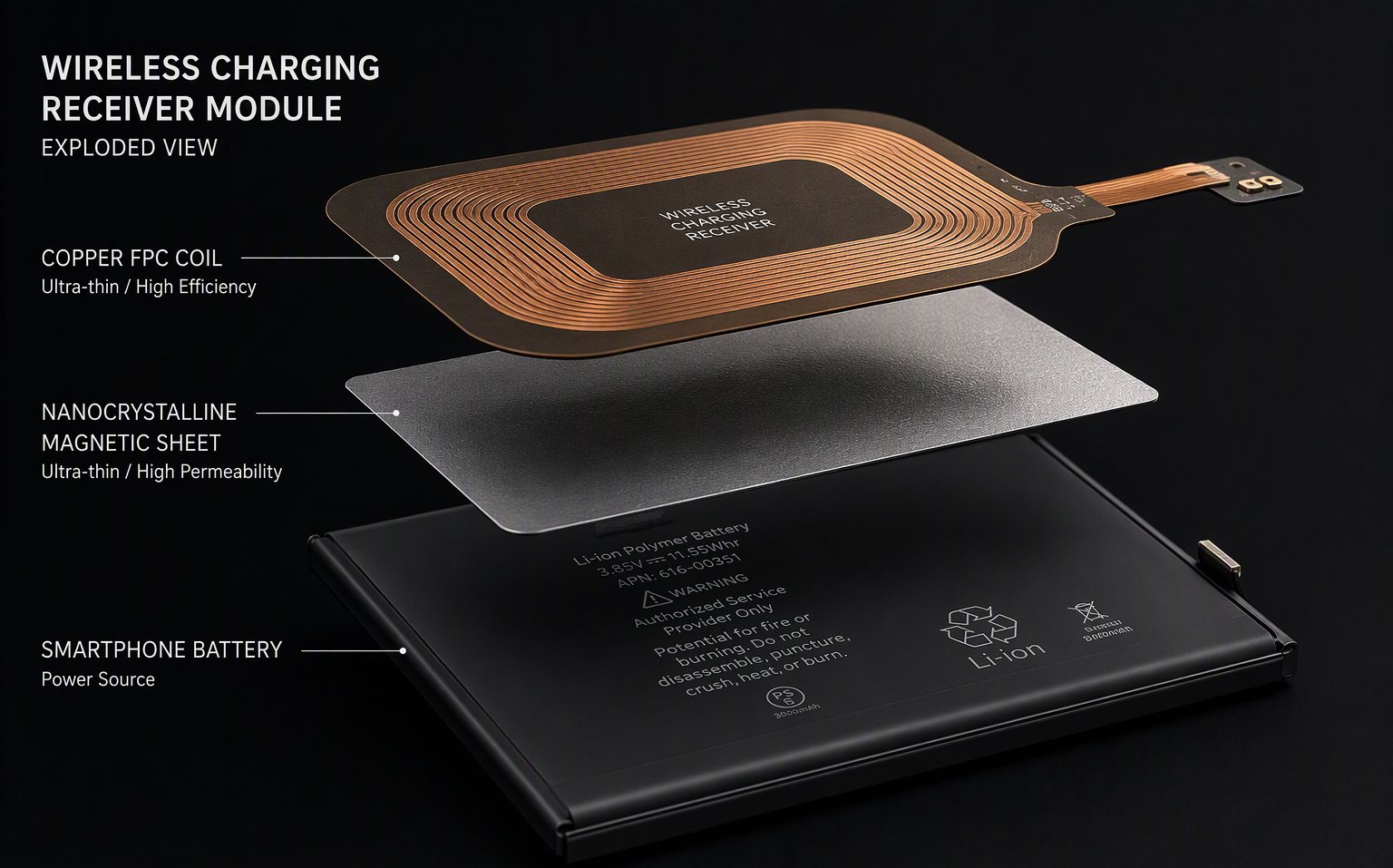
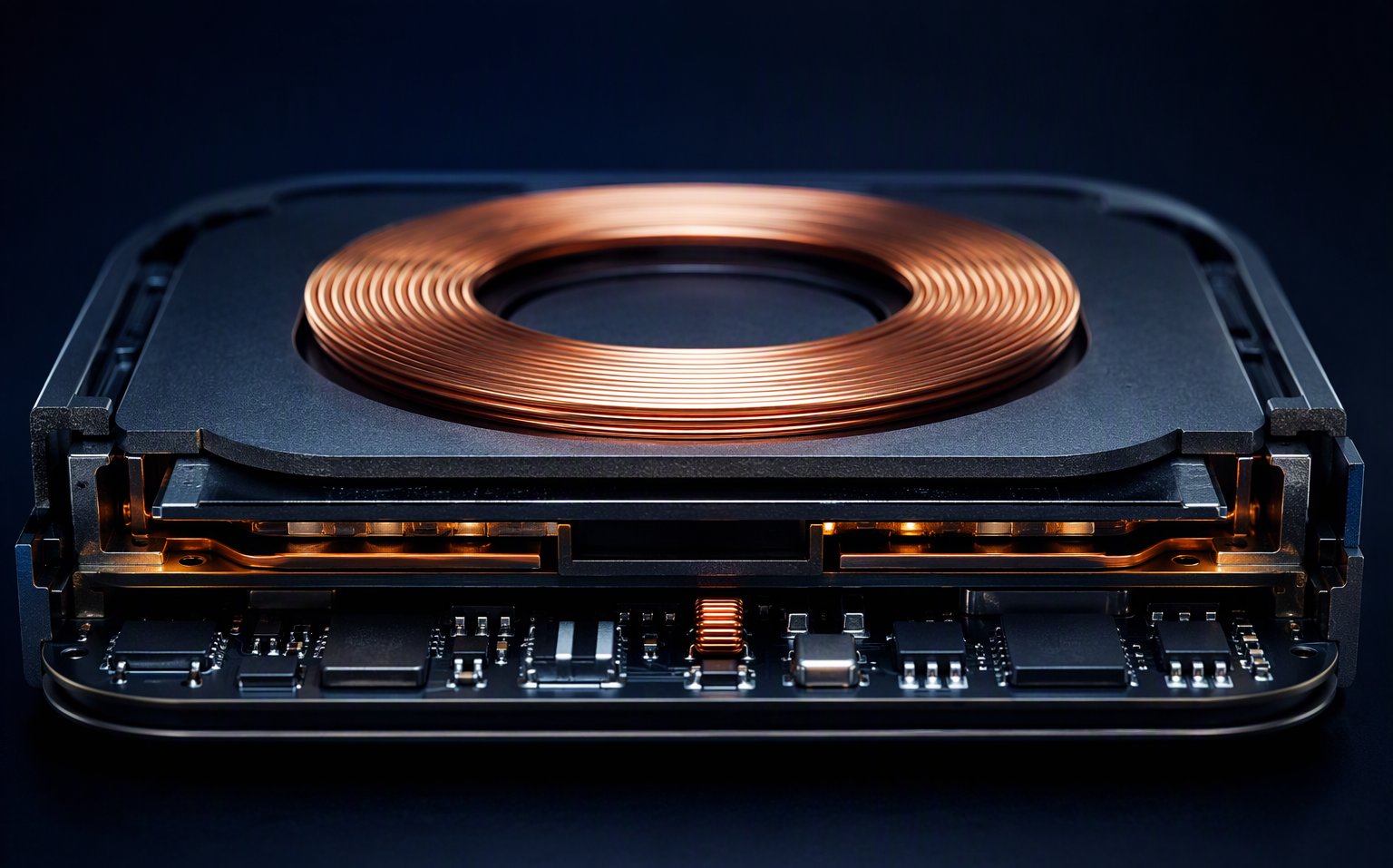
When a ferrite back plate no longer fits — wearables, TWS earbuds, slim RX modules — XAK F-N series nanocrystalline sheets deliver µ′ ≈ 13,000 at 100 kHz in just 0.06–0.4 mm. Flexible, die-cut to your coil outline, and validated for Qi (87–205 kHz) and Qi2 MPP (360 kHz) operation. Response within 24 hours.
Nanocrystalline alloy ribbon laminated to film and adhesive — the high-permeability layer for RX coils, FPC antennas and low-frequency EMI shielding.
Four reasons teams move a design from ferrite to nanocrystalline.
A watch, earbud or card-style RX has 0.3–0.5 mm behind the coil, not the 0.5–1 mm a ferrite plate wants. Nanocrystalline reaches the same inductance boost at a fraction of the thickness — 0.06 mm grades included.
Misaligned charging sends flux into the battery and housing as eddy-current heat. High-µ′ nanocrystalline confines that flux more effectively, and open industry testing reports roughly 7–8 °C lower temperature rise than ferrite at equal charging conditions — verify on your own module before relying on it.
Rigid ferrite plates crack or gap when bent into curved wearable housings. F-N is a flexible ribbon: it follows the radius and still die-cuts cleanly to outline.
Behind an RX coil you need flux concentration toward the TX and protection for the battery/PCB behind. F-N does both in a single thin layer — no separate shield plate in the stack.
We validate the sheet against your operating point — Qi, Qi2 MPP, or a custom WPT frequency — before cutting.
Qi 1.x spans 87–205 kHz; Qi2 MPP is fixed at 360 kHz (the older 127.7 kHz figure is outdated). We characterize F-N at your actual operating point, not at a generic test frequency.
Thinner sheet, lower effective permeability in the assembly. We quote the expected coupling range for your thickness choice instead of promising the datasheet number at any thickness.
DXF in, kiss-cut sheets on release liner out — single-sided PSA standard; double-sided tape or bare sheet on request. Rolls for high-volume lamination processes.
We ship samples of the recommended thickness plus one neighbor. Measure coupling and temperature rise on your real coil and housing — that's the specification that matters.
Typical values for selection reference — final thickness is confirmed against your coil and measurement results.
| Property | XAK F-N Nanocrystalline | Ferrite Sheet (typical) |
|---|---|---|
| Permeability µ′ | ≈ 13,000 @ 100 kHz | 100–150 @ 1 MHz |
| Saturation induction Bs | 1.25 T | ~0.3–0.5 T (Mn-Zn/Ni-Zn class) |
| Thickness | 0.06–0.4 mm | 0.05–1.0 mm (single layer) |
| Form | Flexible ribbon, rolls, die-cut (DXF) | Sintered plate or flexible polymer-bonded sheet |
| Temperature rise | Lower under misaligned charging (open industry testing: ~7–8 °C less than ferrite, equal conditions) | Baseline |
| Material cost | Higher | Lower — still the default for cost-driven builds |
| Best for | Slim RX, wearables, hot-running or curved modules, high coupling density | Standard TX/RX builds with comfortable Z-height and budget |
The four application families behind most of our nanocrystalline projects.
Smartphone and wearable charging where coupling density per millimeter matters. Validated at 87–205 kHz (Qi) and 360 kHz (Qi2 MPP) operating points.
The thin FPC coils in watches, rings and TWS cases need a magnetic backing that bends with the flex and die-cuts to the coil outline. That's exactly the F-N format.
Ultra-thin flux confinement behind coils and antennas in space-critical consumer assemblies — 0.06 mm grades for the tightest stacks.
Communication devices that need low-frequency magnetic shielding or flux control without the weight and brittleness of ferrite plates.
The three-question decision we run before any quote.
The questions engineers ask before moving a design from ferrite.
You don't need a finished specification. Send what you have — we'll confirm material and thickness with you.
Operating frequency — Qi 87–205 kHz, Qi2 MPP 360 kHz, or your custom WPT frequency
Coil outline — DXF or dimensions, plus TX coil if you have it
Space budget — available thickness and gap behind the coil in mm
Targets — inductance/coupling range and temperature-rise limit
Quantities — sample needs and estimated annual volume
Timeline — when you need samples for bench testing
Share your operating frequency, coil outline and thickness budget — we respond within 24 hours with a material recommendation and samples plan.
Request a Material Recommendation → info@xakmag.com