Product Gallery
SmCo & AlNiCo — Shapes for Hot Service
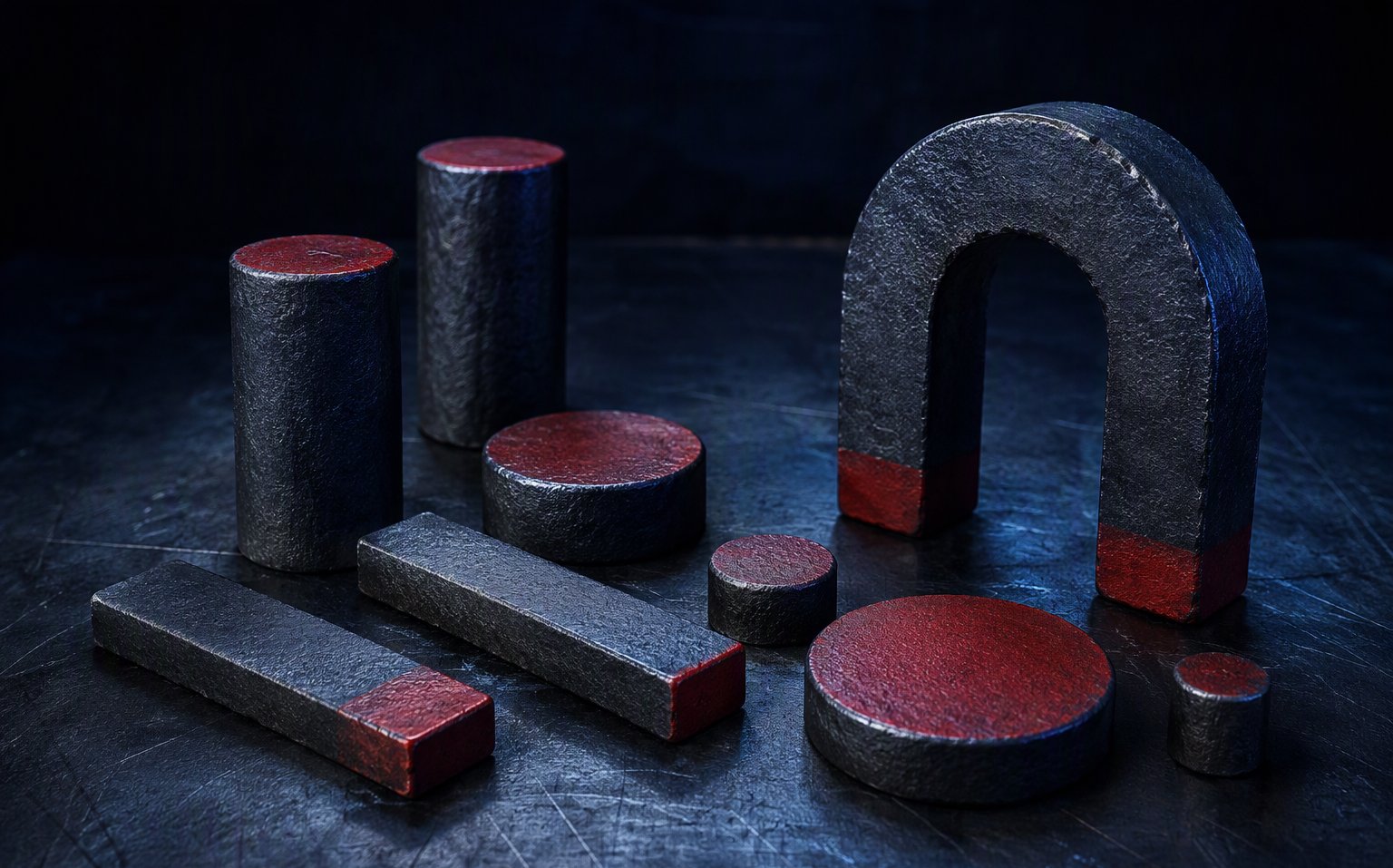
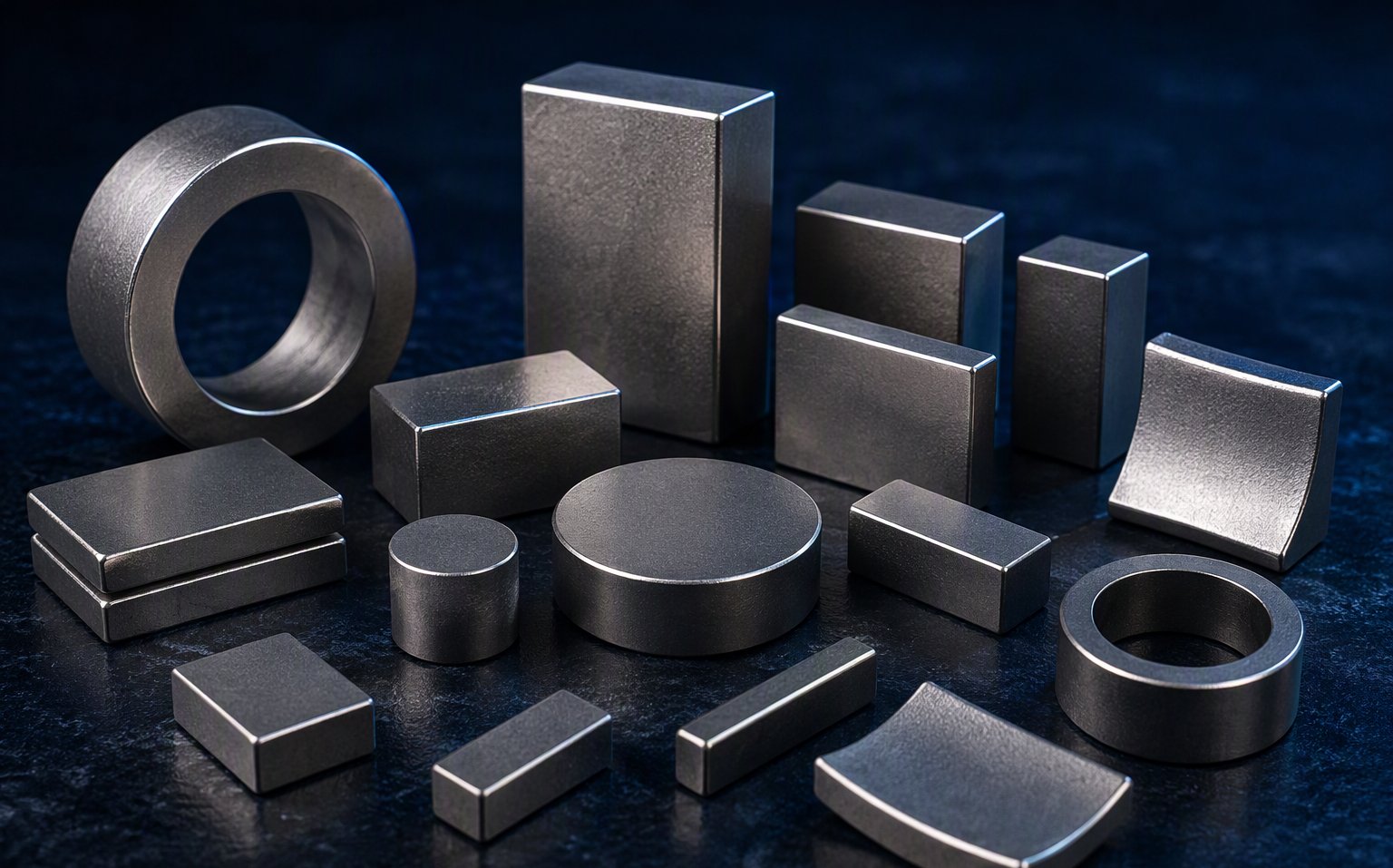
Discs, blocks, rings, horseshoes and custom-ground profiles in samarium cobalt and cast or sintered AlNiCo — supplied bare or machined to drawing, in prototype and production quantities.
When an application runs hotter than NdFeB allows, the choice narrows to SmCo and AlNiCo — and the engineering questions multiply: which grade, which shape, how much holding force remains at temperature, what survives a vacuum chamber. We supply custom high-temperature magnets machined to your drawings, with the selection engineering included. Response within 24 hours.
Discs, blocks, rings, horseshoes and custom-ground profiles in samarium cobalt and cast or sintered AlNiCo — supplied bare or machined to drawing, in prototype and production quantities.
Four failure patterns we see when magnets for hot service are bought as commodities instead of engineered components.
A datasheet Br measured at 20°C says nothing about flux at 450°C. Projects that skip the temperature-derating step discover the gap only after the fixture, rotor or sensor is already built.
Even high-coercivity NdFeB (SH/UH/EH/AH) stops near 200–230°C. Above that, irreversible losses accumulate with every thermal cycle. SmCo and AlNiCo exist precisely for this window — choosing between them is an engineering decision, not a price comparison.
Nickel plating blisters, epoxy outgasses, adhesives creep and let go. At 400°C and above — especially inside vacuum coating equipment — bare, fully dense metal with mechanical retention is often the only acceptable build.
"Holds 10 kg" measured on a bench at 20°C can become a fraction of that at 450°C, in shear, on your actual plate material. If a quote doesn't state the test conditions, the number is marketing, not engineering.
We treat temperature as the first design constraint — not a footnote on the datasheet.
Continuous temperature, peak excursions, cycle count and atmosphere — air, inert gas or vacuum — determine the material window before price is ever discussed.
Br, coercivity and length-to-diameter ratio are chosen as a set: high-flux Alnico 5/9 for long shapes, high-coercivity Alnico 8/8HC for thin discs and short blocks that would otherwise self-demagnetize.
Uncoated AlNiCo and SmCo, mechanically retained assemblies, no adhesives at temperature. Ground surfaces to ±0.05 mm where your fixture demands it.
20–50 piece trials for fixture validation are routine for us, with batch inspection reports. Scale to production volumes when your process is proven.
How the three candidate materials stack up for continuous service above 200°C — a starting point, not a substitute for your full operating profile.
| Material | Typical Grades | Max Continuous Temp | Reversible Temp Coefficient of Br | Where It Wins |
|---|---|---|---|---|
| NdFeB (SH / UH / EH / AH) | 33SH–48SH, UH, EH, AH series | 150–230°C by grade | ≈ −0.12 %/°C | Maximum strength per volume below 200°C |
| SmCo (SmCo₅ / Sm₂Co₁₇) | 16–32 MGOe grades | 250–350°C | ≈ −0.03 to −0.045 %/°C | High strength plus corrosion resistance at elevated temperature |
| AlNiCo (cast / sintered) | Alnico 2, 5, 5DG, 5-7, 8, 8HC, 9 | 450–550°C by grade | ≈ −0.02 %/°C — the best of any permanent magnet | Extreme temperature stability: holding, sensing, instruments |
Typical properties of cast AlNiCo at 20°C, for grade selection reference. Final grade is confirmed against your temperature, geometry and demagnetizing field.
| Grade | Br (T) | Hc (kA/m) | (BH)max (kJ/m³) | Max Continuous Temp | Choose It For |
|---|---|---|---|---|---|
| Alnico 2 | 0.72 | ≈ 45 | ≈ 13 (1.6 MGOe) | 450°C | Isotropic, economical — non-critical shapes, any magnetization direction |
| Alnico 5 | 1.25 | ≈ 50 | 40–44 (5–5.5 MGOe) | 525°C | The workhorse — highest flux of the common grades, long/slender shapes |
| Alnico 5DG | 1.30 | ≈ 52 | ≈ 52 (6.5 MGOe) | 525°C | Semi-columnar version of Alnico 5 — more energy in the same envelope |
| Alnico 5-7 | 1.30–1.35 | ≈ 55 | ≈ 60 (7.5 MGOe) | 525°C | Columnar-grain grade for maximum flux in elongated parts |
| Alnico 8 | 0.80–0.90 | ≈ 120–130 | 40–48 (5–6 MGOe) | 550°C | High coercivity — thin discs, short blocks, holding applications |
| Alnico 8HC | 0.72 | ≈ 140 | ≈ 36 (4.5 MGOe) | 555°C | Highest coercivity — the most demagnetization-resistant AlNiCo |
| Alnico 9 | 1.05–1.12 | ≈ 60 | 72–84 (9–10.5 MGOe) | 550°C | Highest energy product of the family — premium flux at temperature |
The four application families where we supply SmCo and AlNiCo most often.
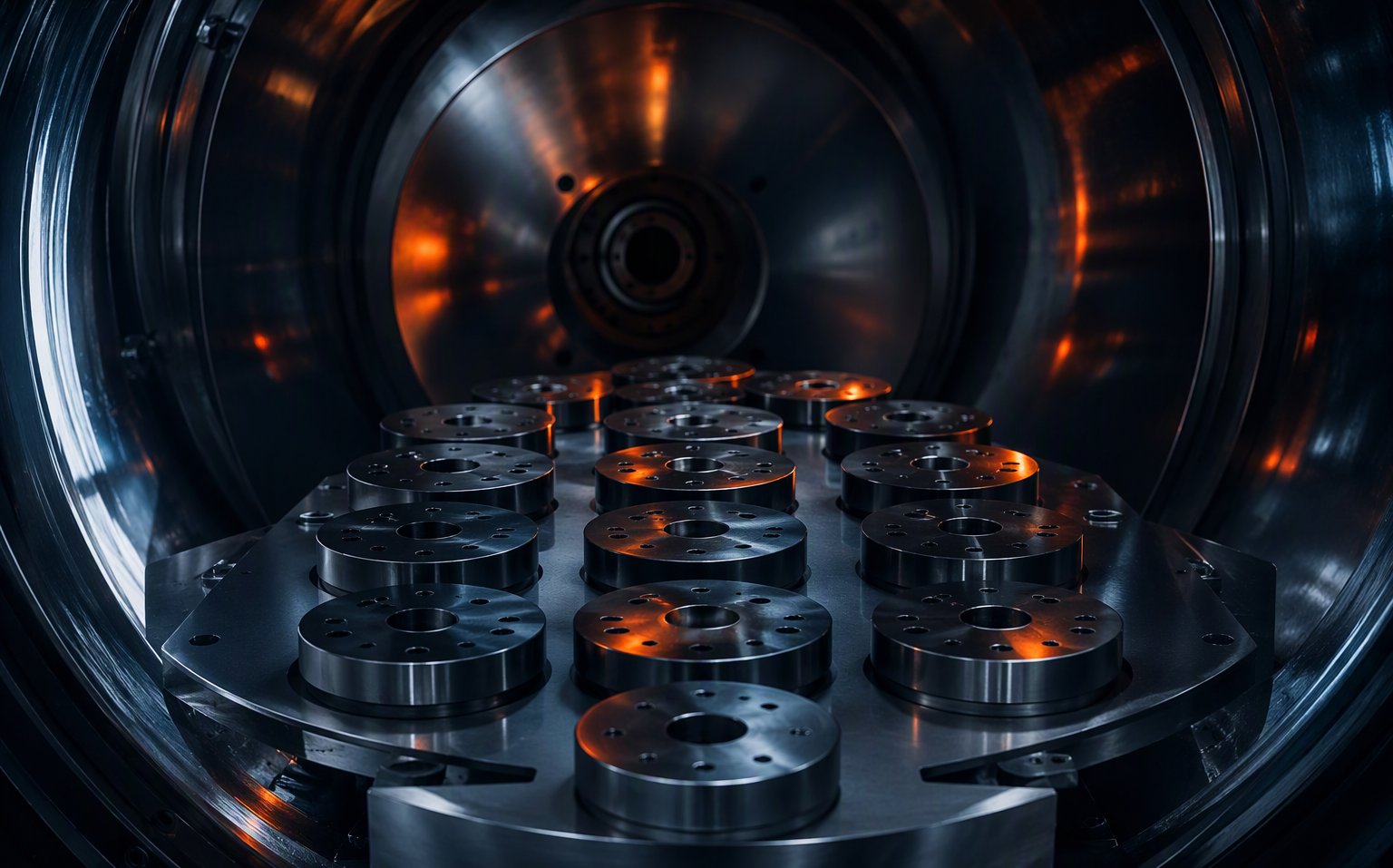
Discs and blocks that hold cutting tools, dies and components on fixture plates at 400–450°C continuous, in vacuum. Bare AlNiCo — no coating to outgas, no adhesive to fail, and flux that barely moves with temperature.
AlNiCo's near-flat flux-versus-temperature curve makes it the reference material for speed, position and temperature-compensated sensing — the reason it has held this niche for decades.
SmCo and AlNiCo in logging tools, MFL inspection and downhole instrumentation, where electronics and magnets both run hot for days at a time. See our energy & oil/gas work.
High-temperature SmCo rotor magnets and AlNiCo assemblies for aerospace, defense and industrial drives where 200°C+ continuous service rules out NdFeB.
What actually changes when the operating temperature leaves the NdFeB window.
The questions engineers and buyers ask us most — including the ones that arrived this month from a PVD coating line running at 450°C.
You don't need a perfect specification to start. Send what you have — our engineers will fill the gaps with you.
Temperature profile — continuous °C, peak excursions, cycle count, and atmosphere (air / vacuum / gas)
Load & mounting — mass to hold, pull or shear direction, plate material, working gap
Geometry — drawing or sketch; current magnet dimensions if you are replacing an existing part
Environment — vacuum level, coating process, chemicals, vibration
Quantities — trial lot size and expected annual volume
Timeline — when you need samples on your fixture
Send your temperature, load and vacuum conditions — we respond within 24 hours with a grade and geometry recommendation.
Request a Technical Assessment → info@xakmag.com