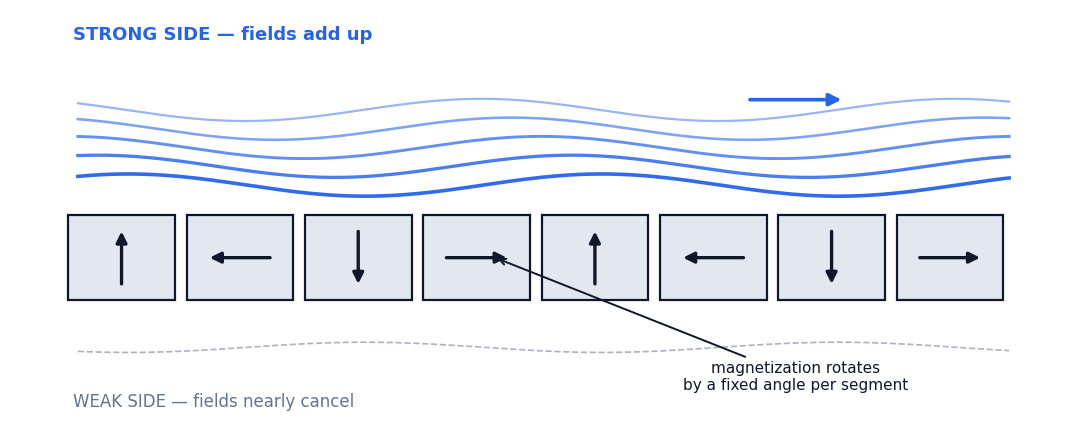
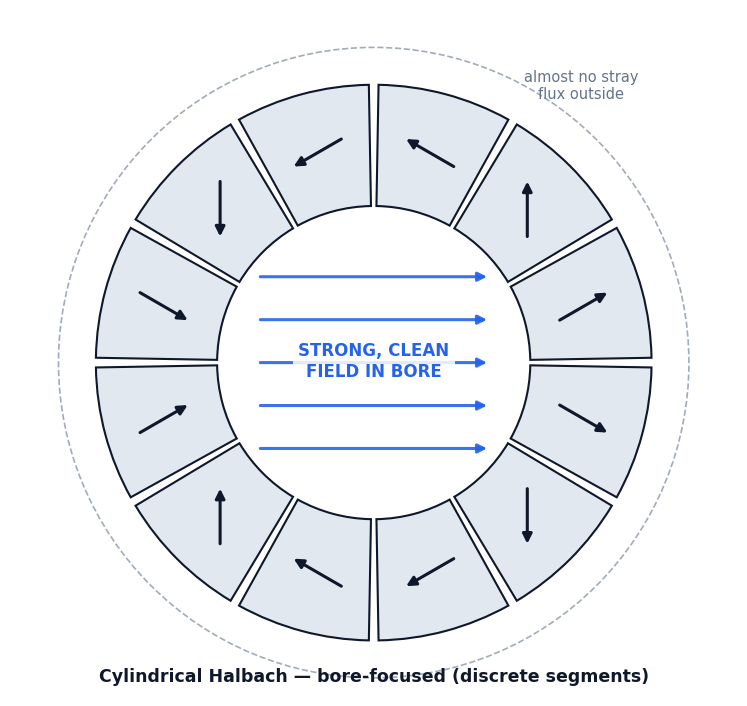
A Halbach array is a magnet assembly with a deliberately rotated magnetization pattern: each segment's magnetization direction turns by a fixed angle relative to its neighbor. The fields add up on one side of the array and nearly cancel on the other — so almost all the usable flux ends up exactly where the design needs it.
That single property explains everything engineers use Halbach arrays for: more torque per kilogram of magnet, cleaner sinusoidal fields, and far less stray flux leaking into surrounding components.
The One Trick: Rotate, Reinforce, Cancel
In a conventional ring magnet, all segments point the same way — radially outward, for example. Flux escapes on both faces, and a steel yoke is usually needed to "catch" the field on the non-working side. That yoke adds weight, inertia and cost.
In a Halbach ring, the magnetization vector rotates segment by segment. On one face the rotated vectors point the same direction and reinforce; on the other they oppose and cancel. The result is a strong, near-sinusoidal field on the working face and a quiet face behind it — often quiet enough to eliminate the back-iron entirely.
Design consequence: removing the back-iron doesn't just save weight. On a motor rotor it cuts inertia; next to sensors and encoders it removes a source of interference; in a coupling it lets the containment shell see less stray field.
Two Geometries You Will Actually Meet
Cylindrical (ring) Halbach
A ring of arc or wedge segments mounted on a hub, with magnetization rotating around the circumference. Two flavors exist: field concentrated inside the bore (used for couplings, magnetic gears, bearings, NMR-type applications) or outside the ring (motor rotors driving an external stator). Pole count and diameter are fully custom.
Linear (planar) Halbach
A flat row of block magnets with rotating magnetization, concentrating flux on one face of the plate. Used for one-sided holding and latching, conveyors, magnetic levitation stages and beamline insertion devices. To a buyer it looks like a simple magnet bar; the value is entirely in the invisible magnetization pattern.
Where Halbach Pays Off
- Robot joints and servo motors — higher torque density in a tight envelope, sinusoidal back-EMF, low cogging, and low-inertia rotors without back-iron
- Magnetic couplings — more transmitted torque at the same diameter, valuable where envelope and weight are capped
- Holding, conveying and fixturing — full holding force on the working face with almost no stray field behind the plate
- Instrumentation and research — controlled field profiles for beamline, calibration and NMR-adjacent work
How Halbach Assemblies Are Really Built
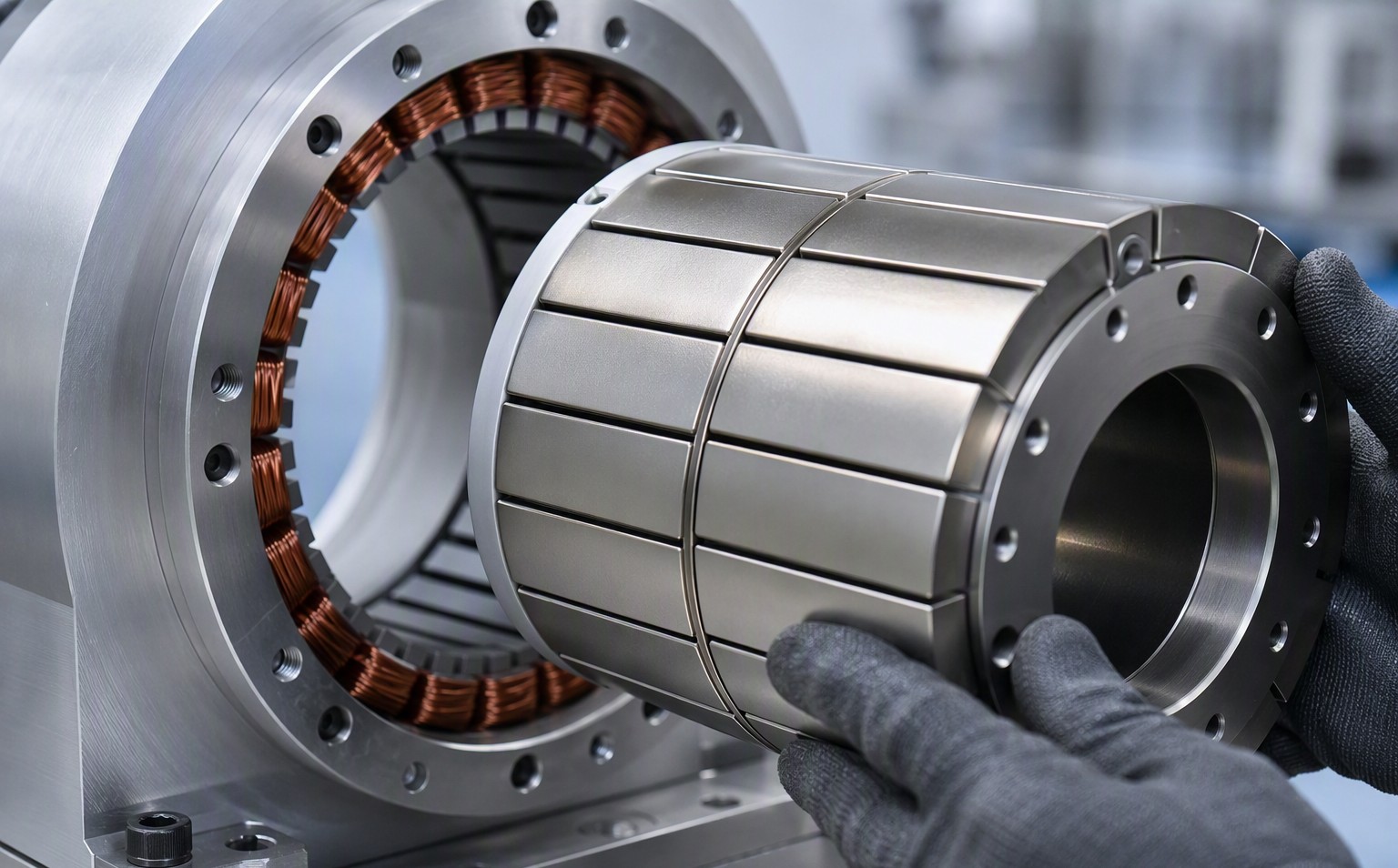
Production Halbach arrays are almost never a single exotic magnet — they are built from discrete pre-magnetized segments, assembled onto a hub or plate with each segment's magnetization angle verified. Three practical consequences follow:
- Standard rotation steps are 30°, 45° and 60° — magnetization fixtures for these angles are standard tooling, so cost and lead time stay reasonable
- Smaller step = closer to ideal — a 30° array approximates the ideal rotating field better than a 60° array, but uses twice the segments and assembly effort
- Non-standard angles are an engineering project — a 31° or 62° pattern needs simulation to verify the field and new fixtures to produce. Feasible, but expect engineering cost and time — the design should justify it
Because every segment's angle and placement must hold, the array's performance is an assembly property, not a magnet property — retention (bonding, sleeve, mechanical lock) and segment control matter as much as the grade you choose.
When Not to Use a Halbach Array
Honesty saves everyone money. A Halbach array is usually not the right answer when:
- A standard radial ring plus a thin steel yoke already meets your flux target — the yoke is cheap, the Halbach premium is not
- Your operating point is cost-driven and volume-high with no envelope or inertia constraint
- The benefit you actually want is raw holding force at very short range, where a simple pot magnet often wins
If you are on the fence, send the operating conditions — sometimes the honest answer is a conventional assembly, and we will say so.
How to Specify a Custom Halbach Assembly
The fastest projects start with six pieces of information:
| What to send | Why it matters |
|---|---|
| Geometry — cylindrical or linear, dimensions, envelope limits | Defines segment shape and count |
| Working side & pole count / rotation step | Sets the magnetization pattern and fixturing |
| Field target — flux density or torque/holding force | Drives grade selection and array size |
| Temperature and environment | NdFeB SH/UH/EH vs SmCo; coating or encapsulation |
| Rotation speed and mechanical loads | Retention design — bonding vs sleeve vs mechanical lock |
| Quantity — prototype, pilot or annual volume | Decides tooling approach and unit economics |
Need a primer on grades first? See our neodymium grade guide. For what the finished deliverable looks like, see custom magnetic assemblies and our work in electric motors & drives.