Product Gallery
Flexible Absorber Sheets, Cut for Your Board
Magnetic powder in a polymer binder — thin, bendable, electrically insulating, and die-cut to your outline with a removable release liner.
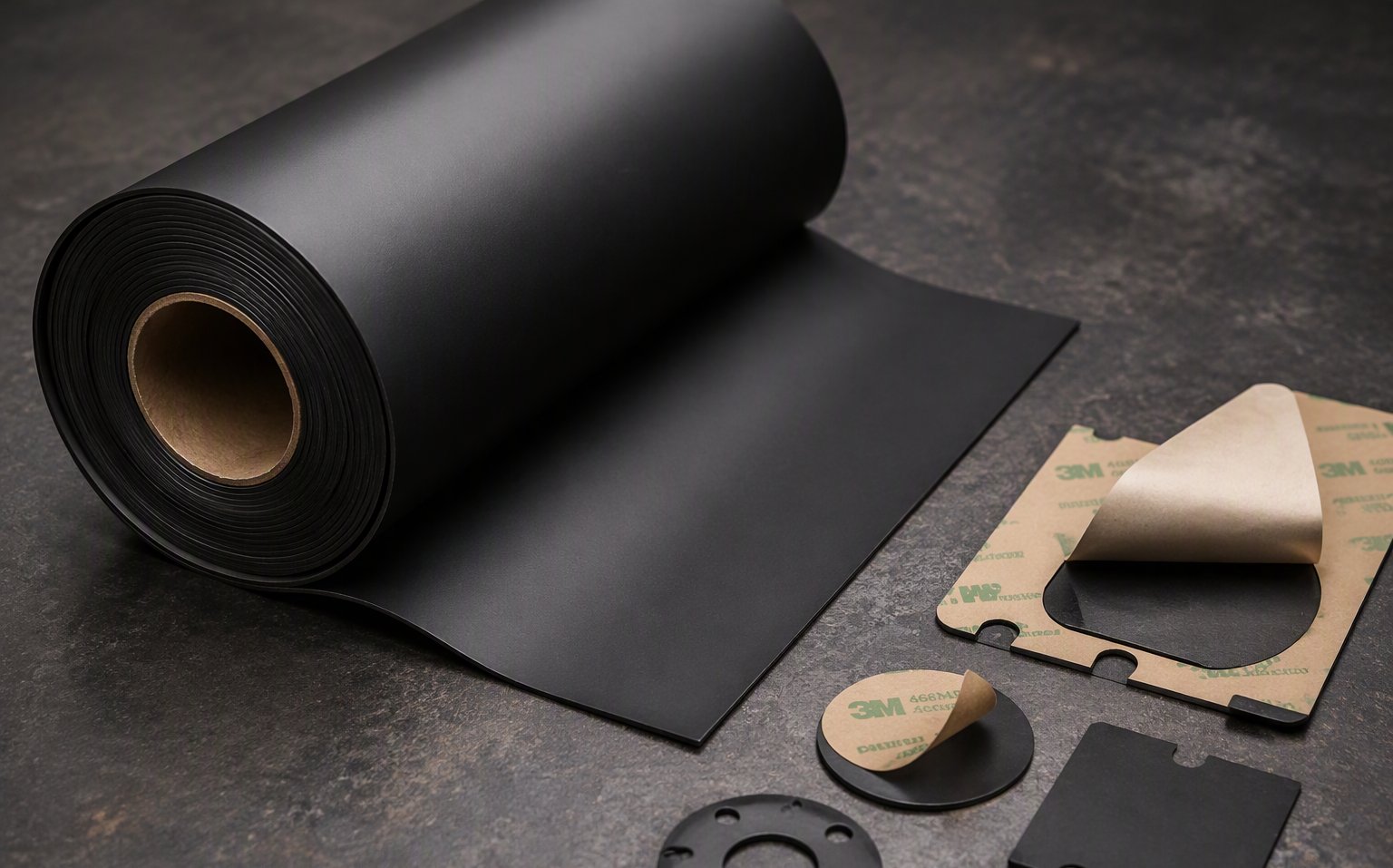
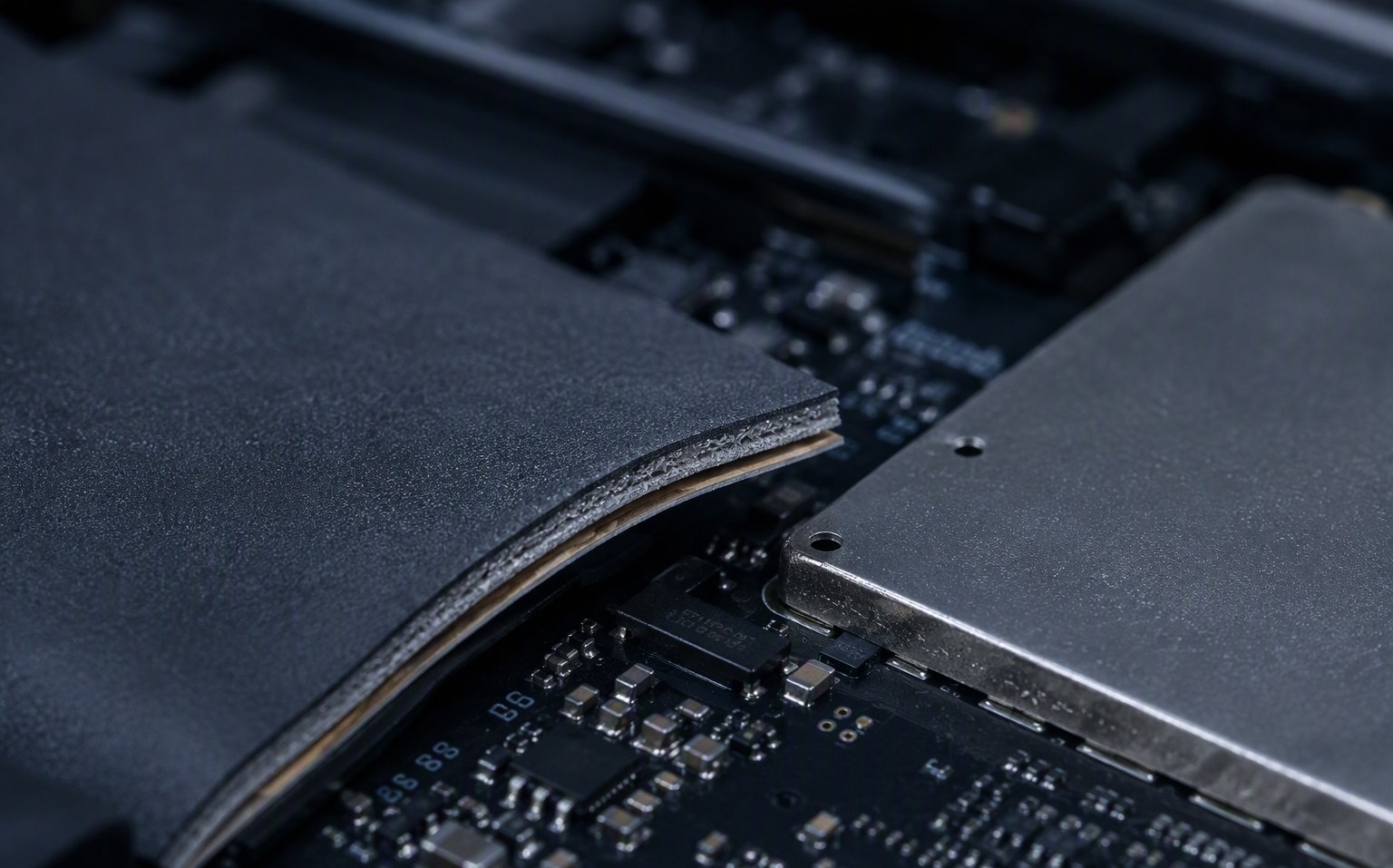

A metal shield reflects EMI — sometimes straight back into your own circuitry. XAK S-A series magnetic absorber sheets work the other way: they dissipate electromagnetic noise as heat across 10 MHz–18 GHz, and double as the standard anti-interference layer for 125 kHz / 134 kHz / 13.56 MHz RFID systems. Flexible, 0.03–2 mm, surface-insulating, die-cut to your outline. Response within 24 hours.
Magnetic powder in a polymer binder — thin, bendable, electrically insulating, and die-cut to your outline with a removable release liner.
Four failure patterns we see when absorber material is missing from an EMI strategy.
A conductive shield bounces radiated noise back — into the cavity between shield and source, along cables, or onto a neighboring board. Reflection doesn't remove energy; it relocates it. Inside a compact enclosure, that relocated energy becomes crosstalk and cavity resonance.
Clock harmonics, DDR switching noise and 5G/Wi-Fi interference at hundreds of MHz to GHz behave differently from kHz-band flux. A low-loss flux-directing ferrite sheet does almost nothing there — you need a lossy material that converts the noise to heat.
Matching a 300 µ′ grade to a 6 GHz problem — or a 20 µ′ grade to a 100 MHz one — gives you a sheet that looks right and performs wrong. Grade selection is a frequency decision, not a thickness decision.
Between shield cans, connectors and keep-out zones, a rectangular pad rarely fits. An absorber that must be hand-trimmed costs assembly yield; one die-cut to your Gerber outline installs in seconds.
We confirm the material against your frequency and target before quoting — the order that saves you sample cycles.
Tell us your noise band — a clock frequency, a failing EMC scan range, a receiver desensitization point. S-A grades are matched to frequency decades, and the wrong decade is the most common ordering mistake.
µ′ 20–300 at 1 MHz across six grades, 0.03–2 mm thick. Lower-µ′, thinner grades serve GHz-range noise; higher-µ′ grades serve lower-frequency suppression and RFID anti-interference. We recommend the combination, not a single number.
Send a DXF or Gerber-derived outline and we deliver kiss-cut pads on a release liner with acrylic PSA — ready for manual or automated placement. Custom shapes, narrow spaces, odd keep-outs: that's the normal job.
Bench and chamber results on your actual board decide the final grade. We ship samples of the recommended grade plus one neighbor, so your EMC scan shows the difference directly.
Typical values for selection reference — final grade and thickness are confirmed against your frequency target and test results.
| Grade (Model Code) | Permeability µ′ @1 MHz | Thickness Range | Typical Use |
|---|---|---|---|
| S-A 2000 | 20 | 0.2–2 mm | GHz-range EMI absorption; thicker stack-ups where space allows |
| S-A 5000 | 50 | 0.03–2 mm | High-frequency noise suppression, flexible thin formats |
| S-A 12000 | 120 | 0.03–0.5 mm | Mid-range EMI suppression, RFID/NFC anti-interference |
| S-A 18000 | 180 | 0.03–0.5 mm | Mid-to-low frequency suppression, harmonic noise |
| S-A 25000 | 250 | 0.03–0.5 mm | Lower-frequency magnetic suppression, crosstalk control |
| S-A 30000 | 300 | 0.03–0.5 mm | 125 kHz / 134 kHz RFID anti-interference, strongest low-frequency grades |
Four application families behind most of our absorber sheet projects.
Over clock lines, PLLs, shield-can lids and connector apertures — the standard fix for harmonic noise and crosstalk in PCs, communication equipment and industrial controllers, from 10 MHz into the GHz range.
125 kHz, 134 kHz and 13.56 MHz readers and tags that must coexist with motors, coils and metal surroundings. The absorber layer isolates the antenna's field from the interference source instead of letting it detune.
Quiet the RX/TX neighborhood: absorber pads localize each device's field and suppress the switching noise that couples into nearby antennas and sensors. Pair with a ferrite or nanocrystalline coupling sheet — the two materials do different jobs in the same stack.
Internal seams, display cavities and shield-to-shield gaps behave like resonant chambers at GHz frequencies. Lossy absorber liners damp the cavity Q and flatten the resonance peaks that show up as radiated-emission failures.
The rules that keep absorber projects out of the sample-and-fail loop.
The questions engineers ask before ordering their first absorber sheet.
You don't need a finished specification. Send what you have — we'll confirm the grade and thickness with you.
Noise profile — failing frequency range or clock frequencies, from an EMC scan if you have it
Source location — which board area, module or cable the noise comes from
Target — required attenuation or the EMC limit you're failing by
Space budget — available thickness and outline in mm (DXF welcome)
Quantities — sample needs and estimated annual volume
Timeline — when you need samples for your next EMC test window
Share your failing frequency range, source location and target — we respond within 24 hours with a confirmed grade and a samples plan.
Request a Grade Recommendation → info@xakmag.com